
What Is LLM-Audit™?
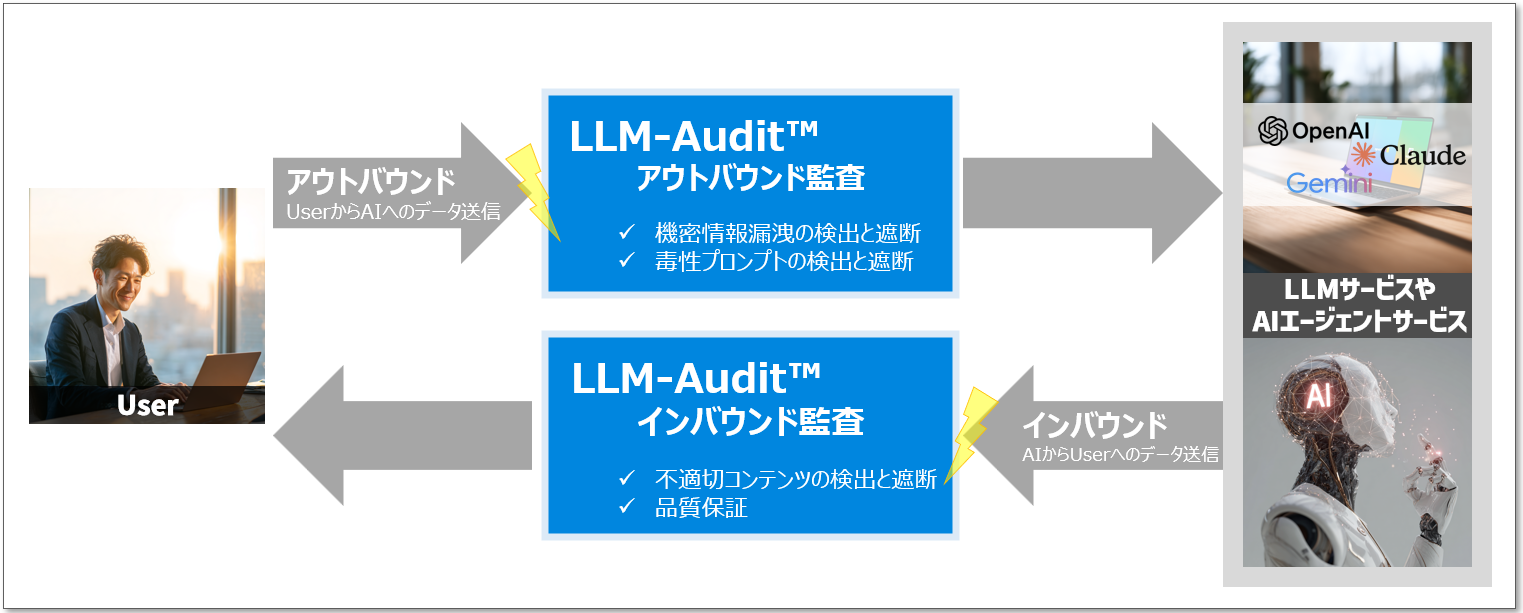
LLM-Audit™ is a comprehensive audit solution for the use of large language models (LLMs) and AI agents.
The solution provides bidirectional auditing of both the data sent to LLMs (outbound) and the data returned from LLMs (inbound),
strengthening security and compliance in your organization's use of AI.
Do These Challenges Sound Familiar?
Serious risks and challenges that many companies face when adopting LLMs
Risk of Confidential Information Leakage
Employees may unknowingly enter confidential information or PII (personally identifiable information) into an LLM, causing it to leak outside the company unintentionally. Once data has been used for training it is difficult to remove, creating a long-term data leakage risk.
Risk of Compliance Violations
Information sent to an LLM service may be unintentionally stored and used for training in a third party's service environment, so companies must properly address regulatory requirements such as corporate confidentiality obligations and the Act on the Protection of Personal Information (APPI).
Risk of Liability for Damages from Erroneous LLM Output
Misinformation or inappropriate answers generated by an LLM can cause harm to customers and business partners, giving rise to litigation risk and liability for damages. In the medical, financial, and legal fields in particular, the consequences can be catastrophic.
Risk of Brand Damage
Inappropriate remarks, discriminatory content, or ethically problematic answers can severely damage your corporate brand image and cost you public trust. In the age of social media, such incidents spread in an instant and cause damage that is hard to recover from.
If these risks are left unaddressed...

[Image: "We didn't know" is no excuse. The price of leaking confidential information to AI services is steep]
Massive damages, sanctions from regulators, customer attrition, falling stock prices, and more
can lead to consequences serious enough to threaten the very survival of your company
LLM-Audit™ Solution Lineup
LLM-Audit offers two solutions depending on what you need to protect
LLM-Audit Enterprise 🏢
Protect your company's data and employees
LLM-Audit Enterprise is an AI security solution for companies that use external LLM services such as ChatGPT and Gemini.
It prevents leakage of your company's data, such as employees inadvertently sending PII (personally identifiable information) or confidential data to those external LLM services, and enables compliance management for your employees.
- Prevent leakage of confidential information and PII
- Manage appropriate LLM use by employees
- Use external LLM services safely
LLM-Audit Cloud ☁️
Protect your own service and its end users
LLM-Audit Cloud is a security solution for companies that provide their own LLM services.
It defends your service against attacks such as prompt injection and jailbreaks, so you can deliver a safe service to your end users.
- Prompt injection countermeasures
- Defense against jailbreak attacks
- Prevention of harmful content generation
Solution Comparison
| Item | LLM-Audit Enterprise 🏢 | LLM-Audit Cloud ☁️ |
|---|---|---|
| Service Overview | A solution for companies that use third-party LLMs (such as ChatGPT) to protect their own data and employees | A solution for companies that provide their own LLM service to protect their end users |
| Purpose | Audit the inputs to and outputs from third-party LLM services | Audit the inputs to and outputs from your own LLM service |
| Primary Protection Targets | • Your company's confidential data and PII (personally identifiable information) • Your employees who use third-party LLM services |
• Your own LLM service • The end users of your LLM service |
| Interface | Proxy server approach (MITM), and others | OpenAI API compatible |
Security Features in Detail
Comprehensive security in both directions, outbound and inbound
Outbound Security (Audit of Sent Data)
This mechanism audits and controls the data sent to LLMs. In Enterprise environments it prevents leakage of confidential information when employees use external LLM services, and in Cloud environments it detects and blocks malicious input such as prompt injection and jailbreak attacks against your own LLM service.
| Feature / Technology | Overview | Example Implementation |
|---|---|---|
| Defense Features |
Data Leakage Prevention (for Enterprise) • Detection of PII (personally identifiable information) such as names, addresses, phone numbers, and email addresses • Identification of corporate secrets (financial information, trade secrets, intellectual property, etc.) • Automatic detection of credentials (passwords, API keys, etc.) • Protection of confidential information defined by your company and industry-specific information through custom rules Attack Defense (for Cloud) • Detection of prompt injection attacks • Blocking of attempts to tamper with the system prompt • Pattern recognition of jailbreak techniques • Prevention of attempts to induce the generation of harmful or illegal content |
• Users who submit toxic prompts are recorded, and users exceeding a certain score are flagged. Persistent offenders are blacklisted, warned, and suspended from the service • PII is detected and fully masked. For pre-registered categories, the data is replaced with fake data instead of being masked and the replacement is reversed when the LLM responds, keeping the LLM working normally while protecting confidential data |
| Control Features |
Flexible Control Options Depending on the identified risk level, the following controls are available • Full block: stop the transmission and state the reason • Masking: send with only the confidential portions hidden • Warning: notify the user of the risk, then allow the transmission • Logging: record all activity as an audit trail |
• Record all logs through custom logic, set risk levels per category for each company and department, and notify, warn, or block according to the risk level. Real-time notification to administrators for specific categories |
| Detection Technology |
Advanced Detection Technology Rather than simple keyword matching, the following technologies deliver staged, high-precision detection • Context analysis: decisions based on an understanding of the context • Machine learning: adaptation to new attack patterns • Rule engine: application of industry- and company-specific policies • Real-time processing: high-speed scanning with minimal latency |
• Because the required detection speed and accuracy are in a trade-off relationship, staged detectors are provided. Simple detectors are regex-based, while advanced ones use high-precision AI-based detection, striking a balance between usability and security |
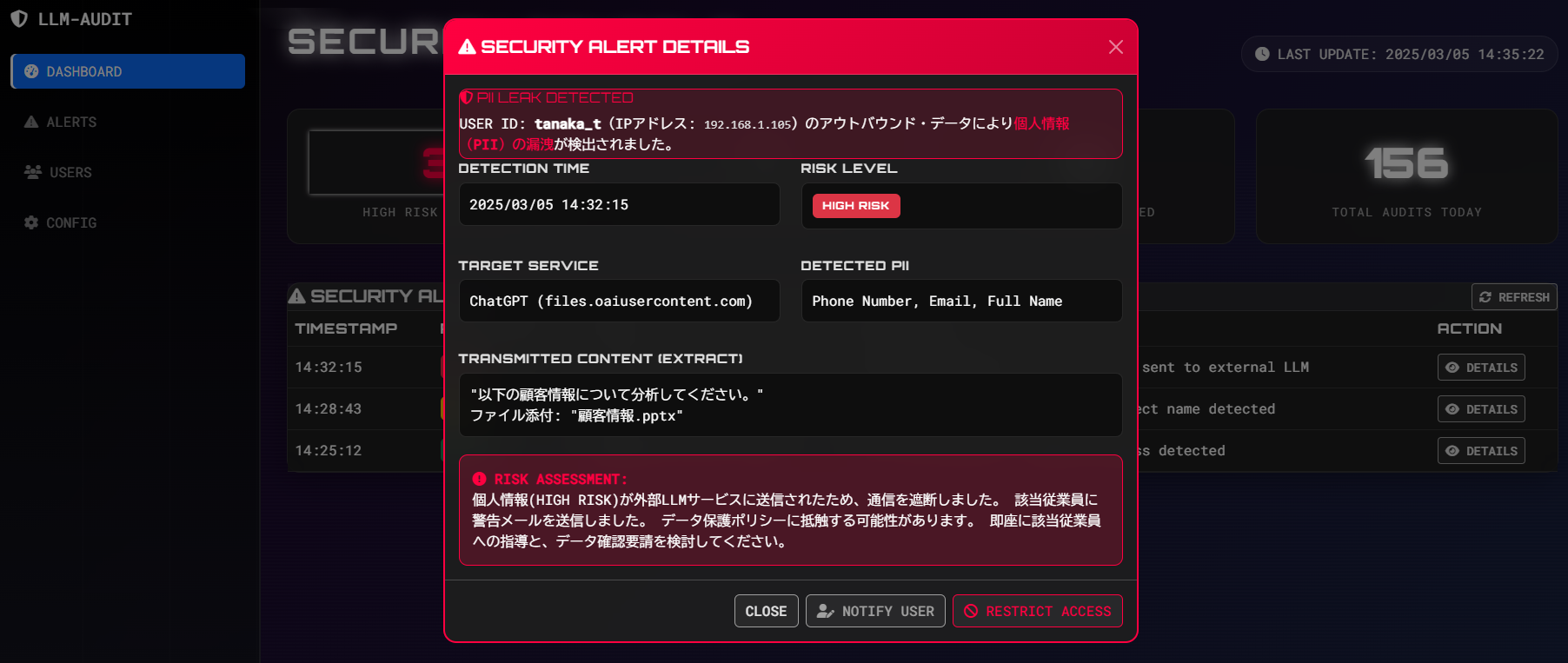
[Image: Outbound security detection screen (features and screens are subject to change without notice)]
Equipped with the Japanese PII Detection Engine "PII-Fi™"
In LLM-Audit™'s outbound security, part of Layer 1 (input filtering) and Layer 2 (data protection) directly incorporates the engine of our in-house developed Japanese PII detection and masking API, PII-Fi™. With a Japanese-specific dictionary of roughly 100,000 words and 7 context-analysis pipelines, it detects and masks with high accuracy everything from personal names with honorifics and address notation variants to context-dependent monetary information.
Learns and detects each company's
"confidential information" from context
PII-Fi™'s greatest strength is that it goes beyond general Japanese PII detection to detect "confidential information" as defined differently by each company. Our proprietary context-analysis pipeline learns from the documents and business records that exist in your company, making it possible to detect from context even information that can only be judged confidential under company-specific rules, such as "internal only," "top secret," "M&A deal codes," and "internal identifiers."
This lets you reliably block or mask, before transmission to the LLM, the "confidential information defined by each company" that conventional general-purpose PII detection tends to miss.
Far faster, cheaper, and more accurate than
assembling conventional solutions yourself
Overseas PII detection tools, Faker, Japanese NLP libraries, regular expressions, dictionaries: building a Japanese-capable PII engine by combining these yourself typically takes months to years of development plus ongoing tuning costs.
PII-Fi™ integrates all of these into a single engine fully specialized for the Japanese language and Japanese culture. Immediately after deployment, it handles with high accuracy corporate names with the "Kabushiki Kaisha" prefix or suffix, dates in the Japanese era calendar or with weekdays, personal names with honorifics, address notation variants, and even linking the same person across mixed kanji, katakana, and romaji spellings.
- A 4-layer approach combining AI-based named entity recognition and rules minimizes missed detections
- High throughput of 1,000+ req/s, with dictionary and detector updates possible without service downtime
- Entity Consistency: the same person is replaced with one consistent dummy name across the entire document
- Natural dummy data generation that preserves the original notation format of phone numbers, addresses, and dates
A proprietary context-analysis pipeline
specialized for the Japanese language and culture
The same "5 million yen" is automatically classified by confidentiality according to context, as personal income (PERSONAL_INCOME) for "annual income is 5 million yen," corporate earnings (CORPORATE_EARNINGS) for "our sales were 5 million yen," and M&A information (STRAT_MA) for "the M&A amount is 5 million yen." Financial PII, credentials, HR and labor, medical and health, corporate strategy, legal and contracts, and internal identifiers, for a total of 7 domains and 48 categories, come standard.
This is a PII-Fi™ original approach not found in the major overseas PII detection services.
Inbound Security (Audit of Received Data)
LLM output carries multifaceted risks, including harmful content, misinformation, exposure of confidential information, quality degradation, and compliance violations. LLM-Audit's inbound security features adopt a staged processing architecture called the audit pipeline to verify each of these risks in multiple layers.
| Detector | Overview | Example Implementation |
|---|---|---|
| Content Filter |
Detects and removes harmful or inappropriate content contained in LLM output • Identifies threats across 14 categories, including violent expressions, sexual content, and incitement to illegal activity • High-precision decisions that take context into account |
• Some LLM services output inappropriate content in certain contexts. In cases where LLM-generated answers are used directly in customer Q&A, inappropriate content is blocked to reduce the risk of damage to corporate credibility |
| Hallucination Detection |
Verifies the factuality of LLM-generated information and identifies misinformation and fabricated content • Detects plausible but factually incorrect "hallucinations" through entity verification and logical consistency checks - Verification using a knowledge base (embedding-based verification) - Verification by self-check (self-check by an LLM) |
• LLMs can hallucinate even when generating general content, such as in business document generation • Triple self-checks prevent hallucinations and greatly reduce the hallucination rate • Connects to your company's own document management system (knowledge base) and judges hallucinations from cosine similarity, reducing hallucinations in fields where LLMs are prone to them (legal, financial, medical) |
| Confidential Information Filter |
Detects and removes confidential information that may be unintentionally included in output • Identifies PII (personally identifiable information), corporate secrets, internal data, credentials, and more with high accuracy • Minimizes the risk of unintended leakage of confidential information contained in training data |
• When fine-tuning on in-house data to build a domain-specific LLM, PII that had accidentally been mixed into the corporate database was learned by the model. When the LLM attempts to output that PII, the Audit PII Detector stops it in advance, preventing PII from leaking to users |
| Quality Check |
Evaluates answer consistency and ensures output that meets business quality standards • Detects mismatches between the question and the answer and revises the output into a natural business document • Detects and controls output that is obviously LLM-generated |
• Detects answers that respond to "Tell me the sales target" with generic business theory and converts them into concise, practical answers • Automatically corrects LLM-typical stock phrases such as "What do you think?" and "from three perspectives" to generate answers in natural Japanese |
| Compliance Check |
Confirms compliance with industry-specific regulatory requirements and legal constraints • Automatically detects and corrects industry-specific regulatory violations • Minimizes legal risk, including automatic insertion of disclaimers |
• In pharmaceuticals and medicine, detects definitive statements about diagnoses or prescriptions and adds a recommendation to see a doctor along with a disclaimer • In finance, identifies profit guarantees and definitive investment advice and automatically adds risk explanations and statutory disclosures • In legal, detects content that amounts to unlicensed legal advice and revises it into wording that encourages consulting a lawyer |
Flexible Architecture: Layered Guardrail Defense
Each security feature is implemented as an independent "guardrail," delivering multi-layered defense optimized for your requirements
LLM-Audit implements each security feature as an independent "guardrail" and combines them flexibly in a pipeline. This "layered guardrail defense" delivers multi-layered defense optimized for your requirements (performance and security).
Processing Flow
The following processing flow makes it possible to detect and handle (mask or block) information leakage and risks to AI services, and to detect and handle harmful content coming from AI services:
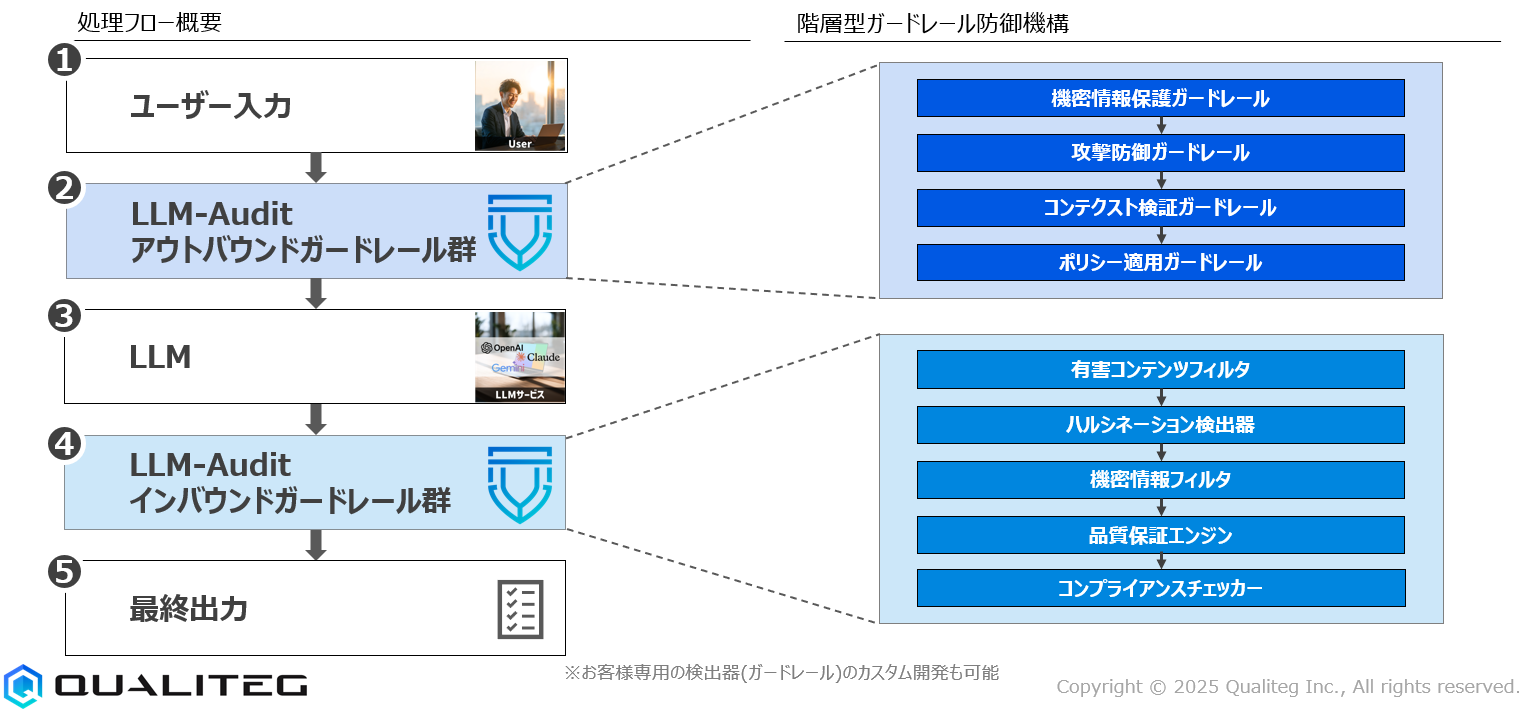
[Image: Architecture diagram of the layered guardrail defense]
Main Guardrails
| Guardrail Type | Guardrail | Overview |
|---|---|---|
| Outbound Guardrails | Confidential Information Protection Guardrail |
Data Leakage Prevention (for Enterprise) • Detection of PII (personally identifiable information) such as names, addresses, phone numbers, and email addresses • Identification of corporate secrets (financial information, trade secrets, intellectual property, etc.) • Automatic detection of credentials (passwords, API keys, etc.) • Protection of confidential information defined by your company and industry-specific information through custom rules |
| Attack Defense Guardrail |
Attack Defense (for Cloud) • Detection of prompt injection attacks • Blocking of attempts to tamper with the system prompt • Pattern recognition of jailbreak techniques • Prevention of attempts to induce the generation of harmful or illegal content |
|
| Context Verification Guardrail | • Understands the context and situation of the conversation to defend against disclosure of information in inappropriate contexts and against attacks that exploit context | |
| Policy Enforcement Guardrail | • Enforces policies such as company-specific rules, industry regulations, and terms of use | |
| Inbound Guardrails | Harmful Content Filter |
Detects and removes harmful or inappropriate content contained in LLM output • Identifies threats across 14 categories, including violent expressions, discriminatory content, and incitement to illegal activity • High-precision decisions that take context into account |
| Hallucination Detector |
Verifies the factuality of LLM-generated information and identifies misinformation and fabricated content • Entity verification and logical consistency checks • Verification using a knowledge base (embedding-based verification) • Verification by self-check (self-check by an LLM) |
|
| Confidential Information Filter |
Detects and removes confidential information that may be unintentionally included in output • Identifies PII (personally identifiable information), corporate secrets, internal data, credentials, and more with high accuracy • Minimizes the risk of leakage of confidential information contained in training data |
|
| Quality Assurance Engine |
Evaluates answer consistency and ensures output that meets business quality standards • Detects mismatches between the question and the answer and revises the output into a natural business document • Detects and controls output that is obviously LLM-generated |
|
| Compliance Checker |
Confirms compliance with industry-specific regulatory requirements and legal constraints • Automatically detects and corrects industry-specific regulatory violations • Minimizes legal risk, including automatic insertion of disclaimers |
Layered Guardrail Defense: Performance Optimization
Each guardrail has an internal hierarchical processing engine, achieving the optimal balance between accuracy and performance.
In PII detection, for example, processing deepens in stages:
High-speed pattern matching (L1) → Structural analysis (L2) → Contextual entailment detection model (L3) → Dedicated LLM (L4)
95% of requests are completed in the fast, shallow layers, and deep analysis is applied only to genuinely high-risk cases,
achieving both millisecond-level response times and high accuracy.
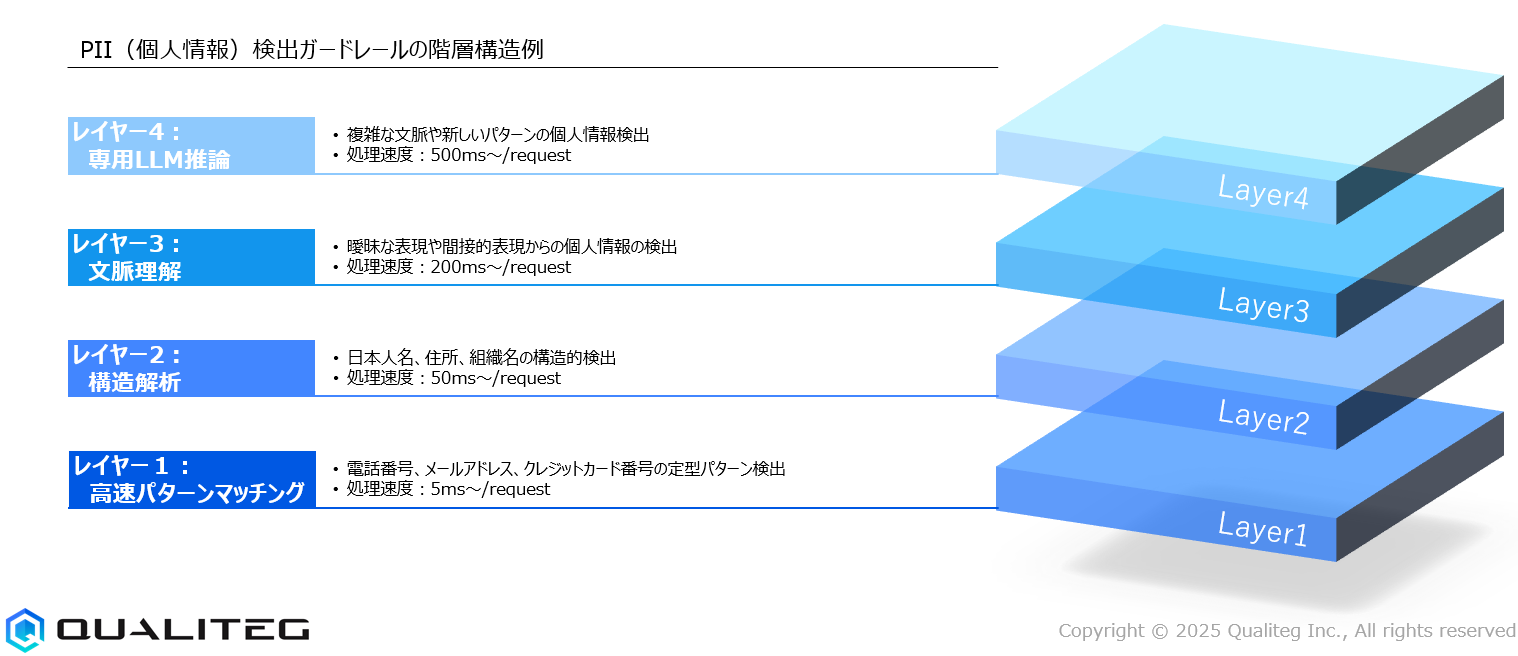
[Image: Conceptual diagram of the hierarchical processing engine (L1 to L4 processing flow)]
Optimized Performance and Accuracy
Processes 95% of requests in milliseconds while targeting a threat detection rate of 99.9% or higher. Parallel processing of independent guardrails minimizes total processing time.
Operational Flexibility
Add new guardrails or update existing rules without stopping systems in operation. Staged rollout through A/B testing keeps the impact on production environments to a minimum.
Business Value
Maintains comfortable response times while meeting advanced security requirements. Apply the optimal security level for each department or use case.
Flexible Deployment Options
Deployment models that put data sovereignty and security first
Choose the deployment environment that best fits your security requirements and compliance obligations
In every option, your data is guaranteed to remain within Japan, and confidential information never crosses national borders.
| Item | On-premises deployment in your own data center |
Qualiteg data center environment | Cloud platform providers (*) Japan regions only |
|---|---|---|---|
| Characteristics |
The highest level of security and data control • Can operate in a fully air-gapped environment • Full integration with your existing security infrastructure • Operation 100% compliant with your internal policies • Guaranteed to run without any external network connection |
Enterprise-grade reliability and security • 24/7/365 operation in Tier 3/4 data centers • Physical isolation on dedicated hardware • Physical security at the level required by financial institutions • Disaster recovery and business continuity |
Scalability and cost efficiency combined • Japan regions of cloud platform providers (AWS and others) • Government-certified government cloud (SAKURA internet and others) |
| Benefits |
When on-premises is the right fit • You need the highest level of security, such as in finance, defense, or critical infrastructure • Regulations require complete physical control • Tight integration with existing systems is mandatory • You do not want any pre-audit data to leave your organization (and want it to remain invisible even to Qualiteg) |
When the Qualiteg data center is the right fit • You want to avoid placing data with overseas companies • Building your own data center is impractical • You want to draw on specialized operational support |
When the cloud is the right fit • You need flexible scaling in response to fluctuating demand • You want a rapid rollout with minimal upfront investment • You have internal rules (a specific cloud platform provider meets your corporate standards) |
* On-premises deployment and Qualiteg data center deployment are offered under the Enterprise plan. The Standard / Professional plans are provided in cloud environments.
We aim to be the most trusted partner for Japanese enterprises
in using LLMs safely, practically, and for the long term
Why LLM-Audit
Deep understanding of Japanese, defenses hardened in real-world operation, expertise in core LLM technology, complete protection from input to output, and readiness for future AI risks
Combining all of these, we deliver genuine peace of mind and practicality as an LLM security solution built for Japanese enterprises
We aim to be the most trusted partner for Japanese enterprises in using LLMs safely, practically, and for the long term
| Advantage | LLM-Audit's strengths | Common challenges |
|---|---|---|
| 1. Unmatched understanding of Japanese |
Developed by native Japanese-speaking engineers, building on more than 10 years of Japanese NLP research and real Japanese-language attack datasets • Draws on a broad technology stack, from morphological analysis to LLMs • Deep understanding of the nuances of Japanese particles and implied meaning • Precise detection of attack patterns unique to Japanese • A risk detection engine that weighs context and tone |
Products designed around English still struggle with sophisticated Japanese-language attack patterns • Limits on Japanese detection accuracy in multilingual products • Interpretation of Japanese context and implication tends to be shallow • Insufficient handling of subtle nuances in particles and honorifics • Response to Japanese-specific attack techniques tends to take time |
| 2. Defenses hardened in real-world operation |
Uses real Japanese-language attack patterns accumulated from operating our own LLM services, ChatStream🄬 and Bestllam™, as a knowledge base • Defense design based on real-world attack cases • An AI red team researches new attack techniques in a hackathon format • The latest attack techniques are reflected in the defense system immediately • Continuous threat intelligence updates |
With little real-world operational data, a gap easily opens between theoretical and actual threats • Divergence between theory-based design and real attack patterns • Few companies yet have a dedicated AI red team • Detection of new attack techniques tends to take time • Limited accumulation of real attack data |
| 3. Deep expertise in core LLM technology |
In-depth knowledge of the latest inference engine technologies such as PagedAttention, TensorRT-LLM, and vLLM • Experience developing and operating GPU inference infrastructure • Comprehensive defense design from the LLM architecture level • High-performance, efficient security implementation • Fundamental, not superficial, security measures |
Without an understanding of LLM infrastructure technology, security measures tend to be confined to the application layer • Optimization at the inference engine level is difficult • Security processing overhead tends to grow • Integrated design of infrastructure and security requires extra effort • Balancing performance and security becomes complex |
| 4. Complete protection from input to output |
Integrates confidential data leakage prevention on input (outbound) with risk auditing on output (inbound) • Full coverage across the entire LLM lifecycle • Attack detection and quality control in one • End-to-end security • A comprehensive risk management framework |
Measures covering only one direction, input or output, cannot cover the full picture of LLM security • Many products specialize in either the input side or the output side • Attack detection and quality control tend to be separate tools • Risk can remain in the gaps between partial measures • Integrating multiple tools adds development and operational cost |
| 5. Ready for future AI risks |
A modular design that adapts flexibly to future regulations and the new threats of the AI agent era • Continuous updates and ongoing security • Long-term protection of your LLM investment • A comprehensive security foundation for evolving AI technology as a whole • Forward-looking design with the responsiveness and extensibility to support guardian agents and more |
A fixed architecture makes it hard to keep pace with the rapidly changing AI threat landscape • Adapting to future regulations and changes in AI technology takes effort • Architecture changes after deployment can be difficult • Constraints on the speed of response to new threats • Preparation for the new risks of the AI agent era is required |
Proven Reliability
A defense system verified through real-world operation of our own services, ChatStream🄬 and Bestllam™. We deliver robust security grounded in real attack data, not theory.
Designed for Japanese Enterprises
A specialist team with a deep understanding of Japan's regulatory requirements, cultural context, and linguistic characteristics delivers a solution optimized for the needs of Japanese enterprises.
Continuous Evolution
Through AI red team research into the latest attack techniques and flexible updates enabled by our modular design, we keep pace with the threats of tomorrow.
Frequently Asked Questions
Answers to the questions we hear most often from those considering LLM-Audit™.
What is LLM-Audit™?
LLM-Audit™ is a comprehensive audit solution for the use of large language models (LLMs) and AI agents. It audits both the data sent to the LLM (outbound) and the output returned from the LLM (inbound), preventing leakage of confidential information, detecting and blocking toxic prompts, detecting inappropriate content, and assuring output quality. As DLP (data leakage prevention) for the AI era, it makes enterprise AI adoption safe.
What is the difference between LLM-Audit Enterprise and LLM-Audit Cloud?
They protect different targets. Enterprise is for companies that use external LLM services such as ChatGPT and Gemini. It prevents leaks caused by employees inadvertently sending PII (personally identifiable information) or confidential data, and enables employee compliance management. Interfaces include a proxy server (MITM) approach. Cloud is for companies that provide their own LLM services. It defends your service against attacks such as prompt injection and jailbreaks, and protects your end users. It can be integrated through an OpenAI API-compatible interface.
What kinds of information can it detect? How accurate is it for Japanese?
It detects PII such as names, addresses, phone numbers, and email addresses; corporate confidential information such as financial data, trade secrets, and intellectual property; credentials such as passwords and API keys; and confidential information defined by your company through custom rules. The outbound audit incorporates PII-Fi™, our in-house Japanese PII detection engine, which uses a Japanese-specific dictionary of roughly 100,000 terms and seven context analysis pipelines to detect personal names with honorifics, variant address notations, and even context-dependent monetary information. It supports 59 PII types, automatic classification of confidential information into 48 categories, a database of 310,000 Japanese names, and a detection latency of 1–15 ms.
After confidential information is detected, how is it controlled?
Depending on the risk level, you can choose between Full Block, which stops the transmission and shows the reason; Masking, which hides only the confidential portions before sending; Warning, which notifies the user of the risk and then allows the transmission; and Logging, which records all activity as an audit trail. For pre-registered categories, the data is replaced with fake data instead of being masked before it is sent, and then reverse-converted when the response comes back from the LLM. This protects confidential data while keeping the LLM working normally. For specific categories, administrators are notified in real time.
What is audited in the output from the LLM (inbound)?
A harmful content filter identifies threats in 14 categories, including violent expressions, discriminatory content, and the encouragement of illegal activity, while a hallucination detector identifies misinformation through entity verification, logical consistency checks, and knowledge-base-backed verification. In addition, it includes a confidential information filter that removes confidential information unintentionally included in the output, a quality assurance engine that detects mismatches between the question and the answer and shapes the output into business-ready documents, and a compliance checker that verifies adherence to industry-specific regulatory requirements.
Does it affect response time?
Each guardrail contains a layered processing engine internally to balance accuracy and speed. In PII detection, for example, processing deepens in stages from fast pattern matching (L1) to structural analysis (L2), a contextual implication detection model (L3), and a dedicated LLM (L4), and 95% of requests finish in the fast, shallow layers. By applying deep analysis only to high-risk cases, it achieves both millisecond-level response times and high accuracy. Independent guardrails are processed in parallel, and guardrails can be added and rules updated without stopping the running system.
What deployment options are available, and where is the data stored?
You can choose from three options: on-premises deployment in your own data center, Qualiteg's data center environment, or the Japan regions only of cloud platform providers (AWS and others, including government-certified government cloud). In all cases, data is kept within Japan, and confidential information never crosses national borders. On-premises deployment and Qualiteg data center deployment are offered under the Enterprise plan, while the Standard / Professional plans are provided in cloud environments. Some features may be limited when using a cloud platform provider.
Can I consult with you about pricing and deployment?
Your first consultation is free of charge. We offer product introductions (feature walkthroughs and a live demo of data leakage detection), AI security consultations (visualizing LLM usage, identifying risks, and industry-specific regulatory compliance), and deployment consulting (requirements definition, integration with existing systems, PoC, and ROI estimation). Plans and pricing are proposed according to your requirements, so please reach out through the contact form.
Contact & Consultation
From deployment consultation and technical evaluation to operational support for LLM-Audit™,
we provide consulting tailored to your company's needs.
Your first consultation is free. Feel free to get in touch.
Contact UsResources
Technical documentation, white papers, and the latest information
LLM Security Blog Articles
Why Has Enterprise Security Become So Complex? From the AD + Proxy Era to Modern Cloud Readiness
A detailed history of how enterprise security evolved, from the firewall-and-proxy era through the shift to SaaS, zero trust, and SASE/SSE. A comprehensive guide for IT security professionals, covering today's IAP adoption, Microsoft Entra ID integration, and applications to LLM security.
Read more →Foundational Technology Behind Enterprise AI Security - Understanding Active Directory Now, Part 4: Proxy Servers and Integrated Windows Authentication
A complete explanation of proxy-based Integrated Windows Authentication, essential for monitoring ChatGPT/Claude. Covers establishing a "chain of trust" by joining the proxy to the domain, the three-stage Kerberos/NTLM/Basic fallback, and everything from a one-hour build with Squid on Windows to a full Linux implementation.
Read more →Foundational Technology Behind Enterprise AI Security - Understanding Active Directory Now, Part 3: Joining Clients and Servers to the Domain
A thorough explanation of what domain joining really means. A practical guide to building an AI security foundation, covering the process of establishing a "trust relationship" between PCs and the domain, automatic authentication with 120-character computer account credentials, Linux integration via Samba, and bulk application of Group Policy.
Read more →Foundational Technology Behind Enterprise AI Security - Understanding Active Directory Now, Part 2: Building the Domain Environment
A hands-on guide to building the Active Directory domain environment that underpins AI security. Details the problems with .local domains and how split DNS solves them, the AD DS role installation and DC promotion process, and optimal DHCP placement by company size.
Read more →The Complete Guide to LLM Security in the Zero Trust Era: Looking Ahead to the Evolution into Guardian Agents
Three transformations are under way at once in enterprise IT environments: the shift from perimeter defense to zero trust, new risks from the spread of LLMs, and the AI agent era. This article explains practical measures for monitoring and controlling LLM traffic with proxy-based security, laying the groundwork for future guardian agents.
Read more →Foundational Technology Behind Enterprise AI Security - Understanding Active Directory Now, Part 1: Understanding the Basic Concepts
Integration with Active Directory is essential for enterprise AI security. This article explains how Kerberos/NTLM authentication through proxy authentication enables transparent user identification and audit trails.
Read more →Essentials and Technologies of Data Leakage Prevention in the AI Era: Part 1, AI DLP and Proxies
The rapid spread of generative AI has brought enterprise data governance to a new stage. While LLMs such as ChatGPT and Claude boost productivity, they also introduce the risk of unintended leakage of confidential information.
Read more →What Are "Guardian Agents", the New Gatekeepers of the AI Agent Era?
An explanation of guardian agents as announced by Gartner. Introduces the three categories of reviewers, monitors, and protectors, along with implementation approaches, for the "AI that protects AI" needed in an era when AI agents act autonomously.
Read more →Staged PII Masking for LLM Use
Explains how to detect "invisible PII" hidden in various file formats such as PowerPoint, Excel, PDF, and images. Introduces the risks in easily overlooked places such as speaker notes and hidden sheets, along with a staged masking strategy.
Read more →The Technology Behind High-Accuracy PII Detection: Embracing the Depth of the Japanese Language
Explains PII detection technology that handles the unique writing system, context dependence, and honorific system of Japanese. Details five levels of technical approach, from regular expressions to large language model integration, and the trade-offs between processing speed and accuracy.
Read more →Defending Corporate Information in the LLM Era: The New Challenge of PII Security
Explains the protection of personally identifiable information (PII) in an era when LLMs have permeated business operations. Proposes countermeasures for "information leakage to AI", a new risk that conventional security measures never anticipated.
Read more →LLM-Audit: The Front Line of LLM Attacks and Defenses
An introduction to LLM-Audit, the LLM security solution we developed. Explains the comprehensive security features that enable safe LLM use, including prompt injection detection, PII protection, and input/output auditing.
Read more →[LLM Security] How to Detect Hallucinations
An explanation of "Lynx: An Open Source Hallucination Evaluation Model", a paper on hallucination detection in RAG. Examines methods for judging the faithfulness of LLM-generated answers and detecting hallucinations.
Read more →[LLM Security] Llama Guard: A First Step Toward AI Safety
An explanation of Llama Guard, developed by Meta. Introduces a safety risk taxonomy for applying safeguards to both the input prompts and output responses of LLMs to prevent inappropriate content.
Read more →[LLM Security] Zero-Resource Black-Box Hallucination Detection
An explanation of hallucination detection in a "zero-resource" setting
Read more →Technical Documentation
Technical documents such as API specifications, integration guides, and administrator manuals are available from a dedicated portal site after contract signing.
LLM-Audit Technical Specification and Architecture Guide
Detailed technical documentation of the system architecture and implementation.
LLM-Audit Integration Guide
Technical documentation detailing configuration guides, architecture patterns, and integration methods for deploying LLM-Audit in your infrastructure
LLM-Audit Administrator Manual
Detailed technical documentation of the system architecture and implementation.
Your first consultation is free. Feel free to get in touch.
Contact Us